
Hawk's Wing
Sarcodon imbricatus




Do not eat any fungi that has not been properly identified by a qualified professional, some are DEADLY when ingested. All edible wild fungi MUST be cooked.
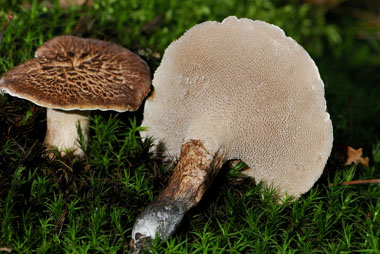
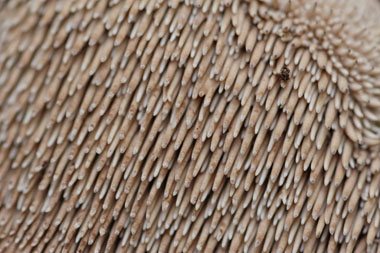
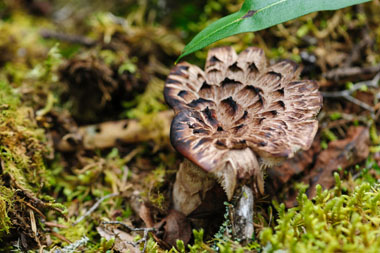
The Hawk's Wing is fairly easy to identify. It has a look-a-like, the Dryad’s Saddle, which also features many dark brown scales. Dryad’s Saddle has pores under the cap, Hawk's Wing has teeth. Dryad's Saddle grows exclusively on dead or dying trees, not on the ground like Hawk's Wing. There is another look-a-like in the Pacific northwest, the Sarcodon scabrosus. This resembles Sarcodon imbricatus but is distinctly bitter, tougher, less palatable, and found with hemlocks and Douglas firs. It is best not to eat this species. Hawk's Wing mushroom provides nutrients like protein, fiber, B vitamins, potassium, copper, phosphorus, and antioxidants, with potential benefits including immune support, fatigue reduction, and cholesterol lowering.

Type
Distinguishing Features
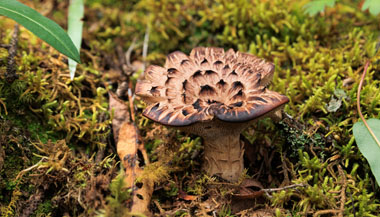
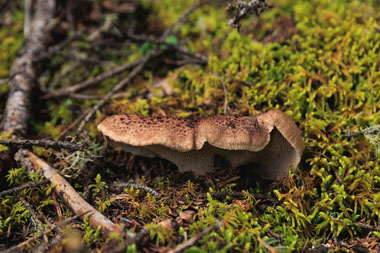
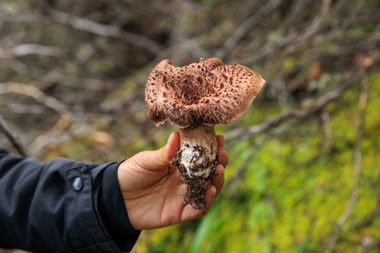
Hawk's Wing is an impressive toothed mushroom. It is easily recognized by its large size, its conspicuously scaly brown cap, and the absence of greenish stains on the stem base. Though it is found throughout North America, this mushroom is especially common in the Rocky Mountains, where it grows under Engelmann spruce and subalpine fir and can reach astounding sizes with caps up to 25 or 30 cm across (approx. 10"). The caps average from 5 to 25 cm (2 to 10") wide. They are convex to broadly convex with a central depression. Hawks Wing's are conspicuously covered with coarse, raised, dark brown to blackish scales; pale to dark brown underneath. The flesh is soft and ranges in color from whitish to pale brownish. When cut or bruised, it does not change color.
Height
On average, this mushroom grows to 10cm (4") and 3cm (1.5") in width.
Habitat
Hawk's Wing is mycorrhizal with conifers and with some hardwoods. They grow alone or gregariously; widely distributed in North America. In the Rocky Mountains, they appear most commonly with subalpine fir and Engelmann spruce. They are often found after a good rainfall.
Spore Print
Brown.
Season
July through to September.
Gills
No gills. The scaly hedgehog mushroom has teeth on its underside. These teeth extend downward from the cap and are pale brown to light to medium brown and darken with age.
Edibility
Although these are edible, they must be cooked. The smaller the mushrooms, the less bitter they taste. The flesh is meaty, dense, and they have an earthy flavor.
Other Name
Scaly Hedgehog.
To support our efforts please browse our store (books with medicinal info, etc.).
Winter Survival Food Handbook

Types of Wild Food


Now available! Beginner's Guide to Safely Foraging for Wild Mushrooms