
White Deadnettle
Lamium album



To support our efforts please browse our store (books with health benefits, etc.).
The white deadnettle is a perennial in the Lamiaceae family that spreads by rhizomatous stolons. It is a good wildlife plant. Some people call this the bee nettle as its flowers attract bees, especially heavier, larger bees. Although recognized as a wild plant, white deadnettle is also grown as a low-maintenance ground cover. Lamium, the genus name, is the Latin word for deadnettle. Plants of this family were once known as Labiatae, and labia means lips. The distinctive two-lipped flowers of the Lamiaceae are sometimes referred to as bi-labiate. The specific epithet album means white and refers to the color of the flowers.
Distinguishing Features
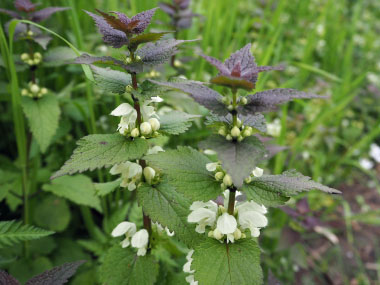
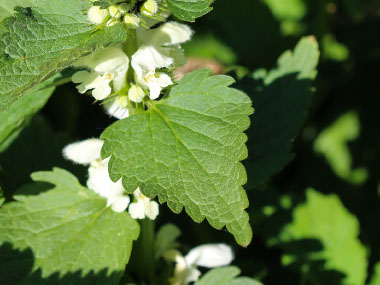
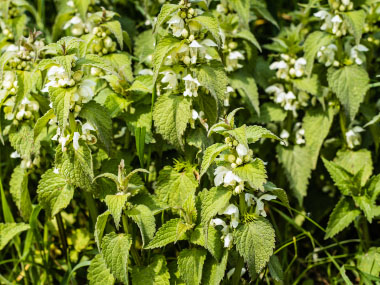
This plant looks quite similar to the purple deadnettle with the exception of the flower color. The plant is faintly aromatic and once it starts to grow in one area, a patch of it will form. It has a distinct square stem and soft leaves. Before the flowers appear it is easy to mistake this plant and stinging nettles. Always look at the stem for trichomes (the stinging structures on stinging nettle) to properly id before harvesting.

Flowers
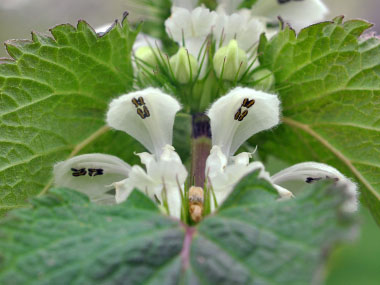
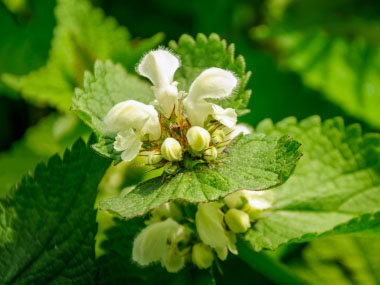
White deadnettle has distinctive white flowers which typically start to bloom in April. Depending on the geographic location, this plant can bloom any time throughout the year. There are three to six flowers per leaf pair. Tubular-shaped flowers have a 1.3 to 1.8 cm long, (0.5 to 0.7”) fused, petals that sometimes are hidden from view by leaf pairs. The flowers have a top hooded petal with 2 lower lip petals.
Leaves
Leaves occur opposite and stalked. Leaf-blades are cordately ovate, net-veined, and both sides are hairy. Leaf margins are large-toothed.
Height
White Dead-nettles grow to a height of 20 to 80cm (8 to 32"). Stem ascending is unbranched, 4-edged, soft-hairs along edges.
Habitat
You'll find this plant in gardens, meadows, hedgerows, along roadsides, and in waste areas. White dead-nettle often grows on fertile and nitrogenous places, sometimes next to stinging nettle. They are native to Europe, Asia, and North Africa but have become widely naturalized across North America, Australia, and New Zealand.
Edible Parts
Young leaves can be enjoyed raw or cooked. Add to salads or mixed with other leaves and cooked as a potherb. They can also be used as a tea. They can also be dried for long-term storage. The leaves contain good quantities of vitamins A, C, calcium, and phosphorus.
Other Name
White Dead Nettle.
Similar Plants
Winter Survival Food Handbook

Types of Wild Food


Now available! Beginner's Guide to Safely Foraging for Wild Mushrooms