
Wood's Wild Rose
Rosa woodsia



To support our efforts please browse our store (books with medicinal info, etc.).
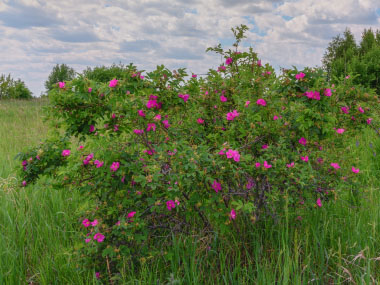
Wood's Wild Rose is a native, woody, deciduous shrub. It is thicket forming and grows prostate to upright. There are many Rosa species with numerous subspecies designations, so 100% identification can be tricky. Rosa woodsii is found only east of the Rocky Mountains in the U.S. and Canada. Rosa woodsia is similar in nearly all respects to Smooth Wild Rose (Rosa blanda), which is the most common of Minnesota's native roses and found throughout the state. Wood's Wild Rose is most easily differentiated by the pair of prickles just below the leaf nodes, but other than that characteristic there is little difference between these two. Also, the Wood's Wild Rose is also known to hybridize with Prickly Wild Rose (Rosa acicularis). Rosaceae. However, all (wild) Rosa shrub species produce edible hips. (Cultivated subspecies often do not.)

Trunk/Bark
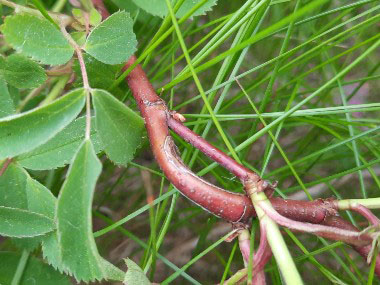
Young bark is typically dark red or reddish-brown. As it matures it becomes a gray or light brown and often develops a rough texture. As the shrub ages, the bark on the lower trunk and older stems turns a light brown or gray and may become rough or irregularly split. Dense thickets can form from spreading rhizomes.
Branches/Twigs
Twigs are initially green, turning red-brown, bearing slightly curved to straight sharp thorns. New stems are reddish brown to purplish. In late spring, new canes form with several prickles on the underside.
Height
1 to 2 metres (3 to 6') tall.
Leaves/Needles
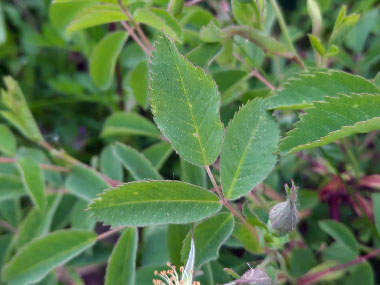
Alternate leaves are compound with 5 to 9 leaflets, frequently 7. Leaflets are 1.25 to 3 cm (1/2 to 1 1/2") long and up to 1.9 cm (3/4") wide, usually widest above the middle. They are rounded at the tip, slightly tapering or wedge-shaped at the base, with serrated edges except on the lower third. Upper leaf surface is dark green and sparsely hairy, the underside is light green and hairy.
Flowers
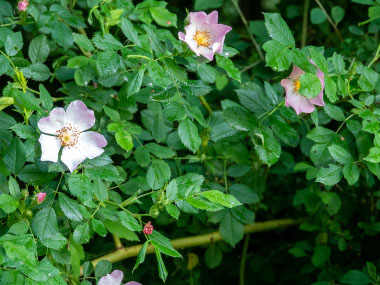
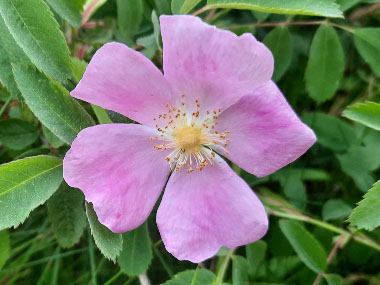
There are 1 to 10 (typically 2 to 4) flowers at the tips of new lateral branches that occur off the older woody stems. Flowers are 3.8 to 6.3 cm (1 1/2 to 2 1/2") across, pale to deep rose pink with 5 broad, rounded petals often notched at the tip. Many yellow stamens surround the shorter styles in the center. Depending on location, the flowers appear June to July.
Fruit
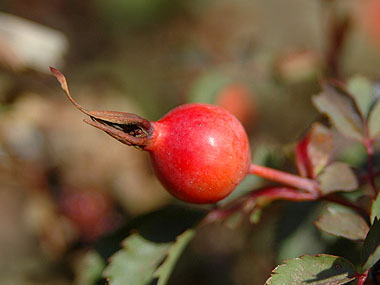
The berry-like fruits (rose hips) are oval to globular, up to 1.27 cm ( 1/2") in diameter, turning bright orange-red to purplish-red in late summer. Each hip produces several seeds.
Habitat
Wood's Wild Rose can be found in part shade to sunny locations. They prefer moist to dry soils. They can be found along woodland edges, riverbanks, and in clearings. This shrub often forms thickets in open locations.
Edible Parts
The fruit (hips) can be consumed raw or cooked. They are used in making jams, jellies, and other baked goods. The taste and texture tends to be best after a frost. The fruit can also be dried and used to make a pleasant tasting tea. Flowers can be used to make a tea. The seeds are a good source of vitamin E. Although labor intensive, dried seeds can be ground into a powder and mixed with flour or added to other foods. The bark, young shoots, and leaves have all been used to make herbal beverages.
Other Name
Wild West Rose.
Winter Survival Food Handbook

Types of Wild Food


Now available! Beginner's Guide to Safely Foraging for Wild Mushrooms