
Yaupon Holly
Ilex vomitoria




To support our efforts please browse our store (books with medicinal info, etc.).
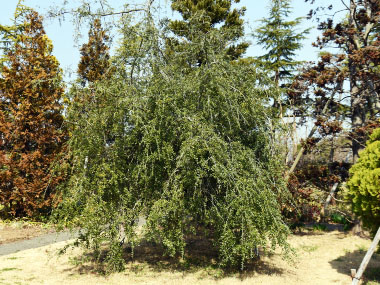
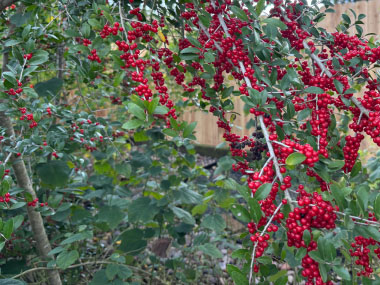
Yaupon holly is a native evergreen shrub (or small tree) known for its glossy, dark green leaves and, on female shrubs, dense clusters of toxic, red berries that persist throughout winter. It is in the Aquifoliaceae (holly) family. Its South American cousin, Ilex paraguariensis, is commonly known as yerba mate. The tea (made only from the leaves) have been historically used by Native Americans for recreation and ceremony. Early white settlers knew the tea as "the black drink." The Seminoles used it ceremonially, boiling it to excess and drinking it to excess, causing vomiting and diarrhea which they felt was purifying. This is where the name Ilex vomitoria originates from. When brewed lightly, however, as you would any other tea, it is pleasant and harmless.

Trunk/Bark
Bark is smooth, thin, and gray with lighter gray-white mottling. Multiple trunks are common. The bark may become scaly with age.
Branches/Twigs
The branching formation is typically dense. Branches are smooth, stiff, and typically light grey. Branches droop.
Height
This shrub/tree can grow anywhere from 5 to 7.5 m (15 to 25') tall.
Leaves/Needles
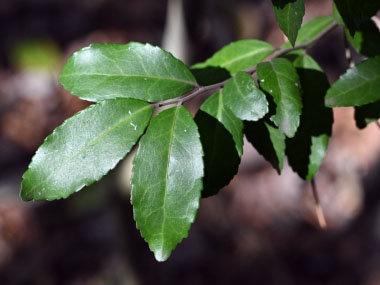
Leaves grow alternate along the stem. Evergreen leaves are smooth, have an elliptical shape, typically measuring up to 2.25cm (1") in length. Leaf margins are toothed. Leaves are glossy dark green on top and lighter green underneath and they maintain their color throughout the year.
Flowers
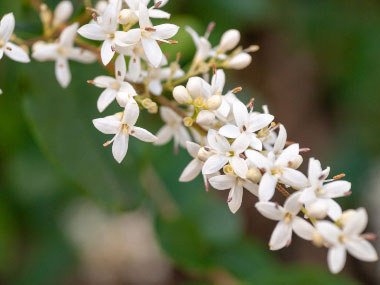
Flowers are white and quite small. They have four petals and are arranged in clusters. The flowers attract bees for several weeks.
Fruit
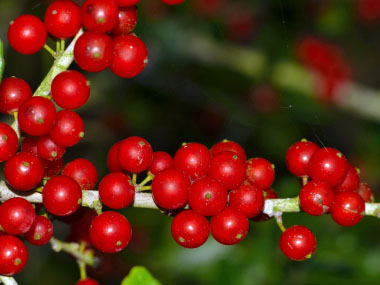
The fruit is a red to black drupe, that measures about 0.5cm (1/4") in diameter. Each berry contains four seeds. Warning: berries are NOT edible!
Habitat
Yaupon holly is found in full sun to partial shade areas in the southeastern U.S. It thrives from Virginia south to Florida, and west to Arkansas and Texas. It is highly adaptable, growing in dry to wet, well-drained sandy or clay soils. Many gardeners like growing this shrub because it is drought-resistant.
Edible Parts
Tea is made from the dried and roasted leaves. As tea, it contains about 60mg of caffeine per cup.
Other Name
Evergreen Holly.
Winter Survival Food Handbook

Types of Wild Food


Now available! Beginner's Guide to Safely Foraging for Wild Mushrooms