Arrowroot Balsamroot
Balsamorhiza sagittate



To support our efforts please browse our store (books with health benefits, etc.).
Arrowroot balsamroot is a unique plant that can take five to ten years to establish. It is drought-resistant, can tolerate trampling and grazing, has good winter hardiness, and it can survive in semi-shade. Aerial parts may be destroyed by fire, but its strong and persistent root system usually allows it to regenerate. Being part of the same family as the sunflower, Asteraceae, they share a similar appearance. It is fairly common in cold, dry areas of western U.S. and Canada. Arrowleaf balsamroot contains antibacterial compounds and has been used as an herbal medicine.
Distinguishing Features
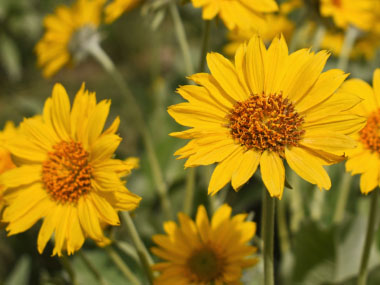
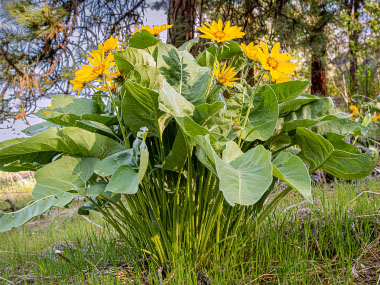
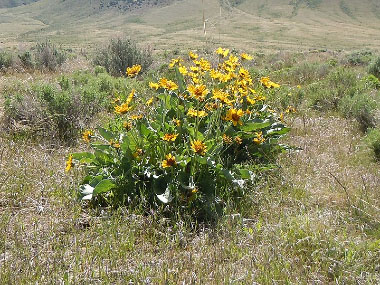
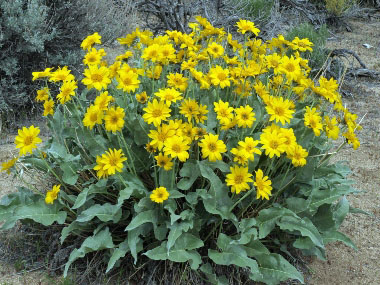
It is easy to spot arrowroot balsamroot when it is in bloom. The bright yellow flowers, arrow-shaped leaves and growth pattern are distinct. It grows in clumps and can reach to just short of a metre (3').

Flowers
Flowers typically grow one per (almost) leafless stalks. They are yellow, are 6 to 12 cm (2.5 to 4") wide, and typically bloom late spring to mid-summer.
Leaves
Basal leaf blades are sagittate measuring 10 to 30 cm (4 to 12") long. Leaves are covered in woolly, grayish-green, fine hairs giving them a silvery appearance.
Height
Stems are erect and can grow 15 to 80 cm (6 to 31") tall.
Habitat
Arrowroot balsamroot is found in grasslands, sagebrush steppe; in valleys, and in montane ecosystems.
Edible Parts
Young shoots and early leaf stalks can be eaten raw or cooked. Leaves can become highly bitter and resinous as the plant matures. When peeled, the inner white stem has a celery-like flavor. The seeds are very nutritious and can be dried, roasted, or ground into a flour. The large taproot is the most calorie-dense part, but it contains inulin that can be difficult to digest for some people. Traditionally, roots were slow-roasted for days to convert the inulin into sweet, digestible sugars. They can also be dried and ground into a powder and used as you would coffee.
Other Name
Oregon Sunflower.
Winter Survival Food Handbook

Types of Wild Food


Now available! Beginner's Guide to Safely Foraging for Wild Mushrooms