Northern Bedstraw
Galium boreale



To support our efforts please browse our store (books with health benefits, etc.).
Northern bedstraw is a resilient perennial plant. It is moderately drought-tolerant and can survive dry spells, but it thrives best in medium-moist, well-drained soils. Older plants can tolerate dry conditions better. In the autumn, the foliage takes on a mix of green, yellow and red hues. Northern bedstraw is native to the U.S. and Canada, and it is widespread throughout the temperate and subarctic regions of Europe and Asia. Galium boreale is a plant species of the Rubiaceae family.
Distinguishing Features
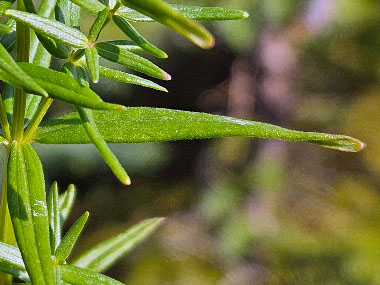
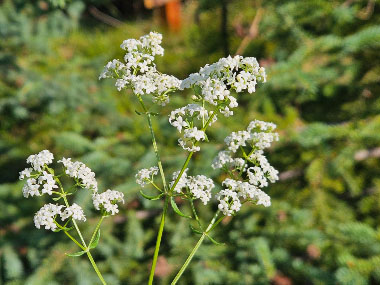
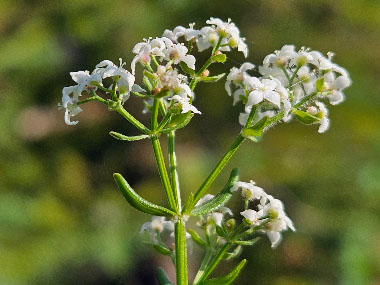
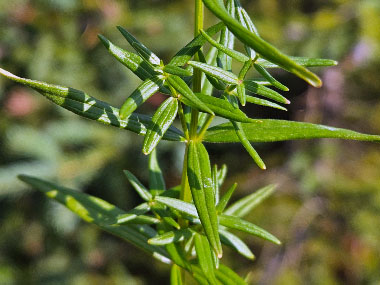
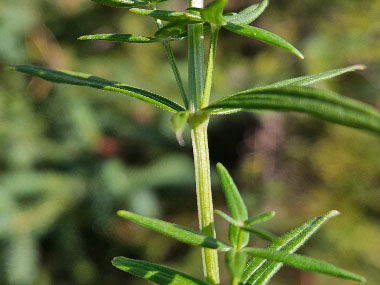
This plant can be easily identified. From a short distance it has a yarrow appearance but upon closer examination, the leaves clearly have the bedstraw look. The flowers occur in an almost umbel formation and each flower is white, tiny, and somewhat star-shaped. Stems are erect, smooth and square, branching in the upper part of the plant. It also has whorled, green leaves.

Flowers
There are many delicate, tiny, white flowers in branching clusters at the top of the stem which arises from the leaf axils. Each individual flower measures 3 to 6mm (1/8 to 1/4") across with 4 petals pointed at the tip. Each flower also has 4 creamy-tipped stamens. Flowers bloom anytime from June into August depending on geographic location.
Leaves
Leaves are in groups of four, whorled around the stem. Each leaf has a somewhat smooth margin with very fine hairs, and it tapers to a blunt point at the tip. Leaves vary in size from 2cm to 5cm (3/4 to 2") long and about 6mm (1/4") wide.
Height
Northern bedstraw grows anywhere from 30cm to 1 metre tall (1 to 3').
Habitat
This plant does well in full sun or part shade, rocky slopes, in open woods, prairies, riparian areas and in fields.
Edible Parts
Leaves are edible but not that desirable. Best used to make a tea. It has a mildly sweet smell and taste, and can be eaten in a salad. Consume in moderation as it is a diaphoretic and diuretic.
Other Name
Fragrant Bedstraw.
Similar Plants
Sweet Woodruff.
Winter Survival Food Handbook

Types of Wild Food


Now available! Beginner's Guide to Safely Foraging for Wild Mushrooms