
Slender Nettle
Urtica gracilis



To support our efforts please browse our store (books with health benefits, etc.).
Slender Nettle is a native plant to North America and is found throughout temperate and boreal areas of North America. It is particularly common in the western and northeastern United States, Alaska, Canada, and is occasional found in the southeastern United States. It is an introduced plant in some European countries as well as in South America and New Zealand.
Distinguishing Features
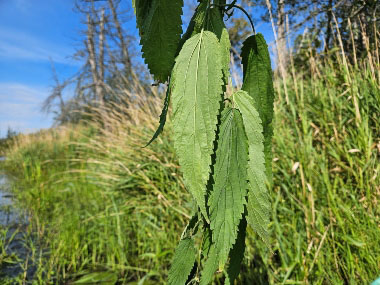
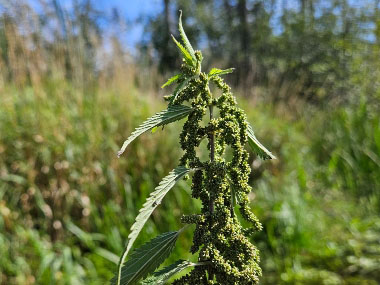
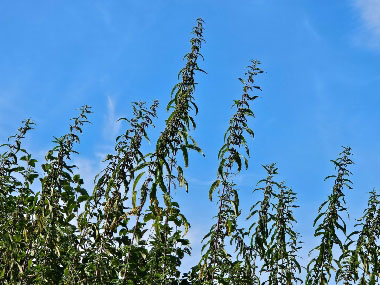
This species of nettle has be far fewer trichomes (stinging hairs) than its close cousins, Urtica dioica (Stinging Nettle) and Laportea canadensis (Wood Nettle). Slender Nettle grows quite tall and has slender leaves whereas the Stinging Nettle is much shorter and has wider leaves.

- click for video -
Flowers
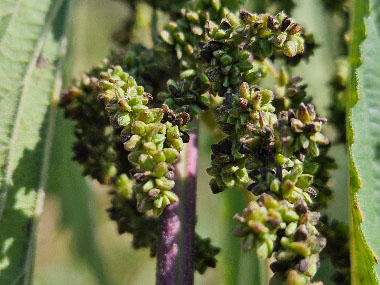
Panicles of flowers grow from the axils of the middle to upper leaves. They are multi-branched and they droop downward. Slender Nettle flowers are monoecious to slightly dioecious; some plants have male flowers entirely or predominantly, while other plants have female flowers entirely or predominately. They bloom during the summer and can last 1 to 2 months for a colony of plants. Flowers are wind pollinated. Brown seeds are very small, measuring 1 to 1.5 mm. long. Seeds can remain viable in the ground for 10 years.
Leaves
Leaves grow opposite one another along the stem. They are lanceolate to narrowly oval or heart-shaped at the base, tapering to a sharp point. They range in size from 5 to 20 cm (2 to 8") long. The margins are serrated. Leaves have trichomes mostly on the underside of the leaves (especially along the prominent veins).
Height
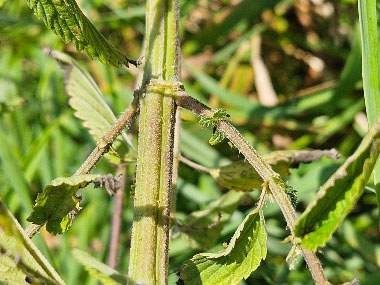
This plant grows anywhere from 1 metre to over 2 metres (3 to 7'). The stem is usually unbranched, although sometimes short stems may grow from the leaf axils. The stem is light green and stout; it has several flat ridges that are separated by narrow channels. It is sparsely covered with trichomes of variable length; these can sting when touched.
Habitat
Slender Nettle grows in alluvial woods, margins of deciduous or mixed woodlands, fields, open woods, thickets, along shores, wet ditches, and prefers moist soils.
Edible Parts
Young leaves can be enjoyed in soups or cooked in casseroles, stews, etc. Slender nettle is a very nutritious food, high in vitamins and minerals. It has been used by many First Nation people to treat a variety of inflammatory and metabolic conditions.
Similar Plants
Winter Survival Food Handbook

Types of Wild Food


Now available! Beginner's Guide to Safely Foraging for Wild Mushrooms