
Soft Stem Bulrush
Schoenoplectus tabernaemontani




To support our efforts please browse our store (books with health benefits, etc.).
Soft-stemmed bulrush has a nearly worldwide distribution and is found throughout North America. It is a common wetland species that grows around lake and river shores, marshes and ditches. Schoenoplectus tabernaemontani is formerly known as Scirpus validus. This bulrush is often found in standing water up to 3' deep along lake and pond margins, and generally forms dense stands. Soft-stem bulrush is a member of the Cyperaceae family which includes the genera Carex, Eleocharis and Scirpus. It is a rhizomatous, emergent aquatic, perennial graminoid.
Distinguishing Features
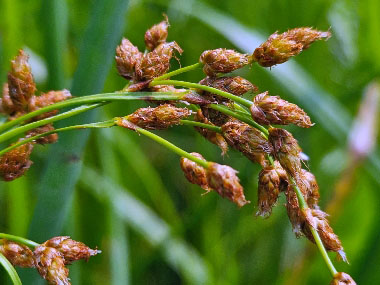
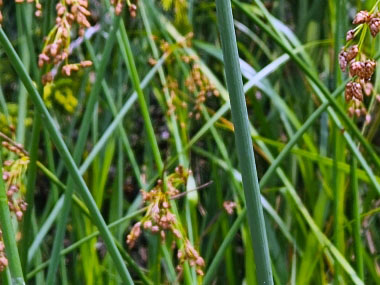
Soft-stem bulrush is characterized by its tall, thin, hollow foliage that has some vertical lines when very young. These patterns are seen in early spring but tend to diminish in summer. Bulrushes can be found in the same environments as cattails and are notably different in structure from the cattails. Soft-stem bulrushes have an erect, tall stem and at the top are notable brown spikelets.

Flowers
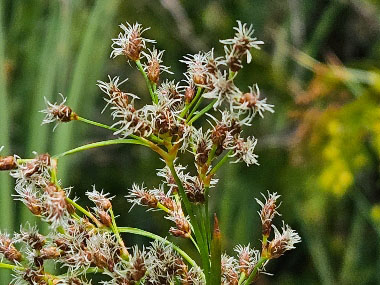
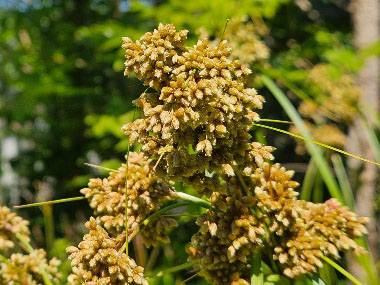
The soft stem bulrush has terminal, drooping panicles. They are very small spikelets that are reddish-brown to orange-brown containing wind-pollinated flowers that bloom from spring through summer. Each plant has 15 to 200 spikelets (flower clusters) on slender stalks.
Leaves
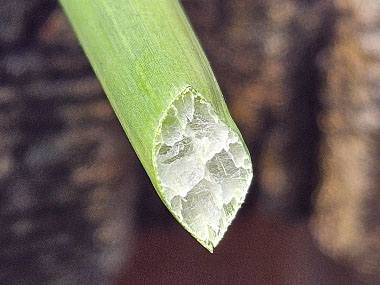
Near the base of the stem, there are 3 or 4 leaves; only the upper 1 or 2 may have a blade longer than the sheath. Stems are erect, round, light blue-green when young, dark green as they age, spongy, and easily compressed when gently squeezed. In cross-section image, air cavities are visible.
Height
The stems can reach anywhere from 1 to 3 metres (3 to 9') tall and they are erect. The height depends on several factors such as the location, substrate, climate, and more.
Habitat
These bulrushes can be in part to full sun locations that are wet. These areas include around lakes, bogs, ponds, fens, wet ditches, fens, bogs and in some marshlands. They grow throughout North America along with other bulrush species. They are native to many locations throughout North and South America, Europe, Asia, Africa, and Australia.
Edible Parts
Seeds, pollen, young shoots, the stem base and rhizomes are edible. Although labor intensive in terms of foraging, the pollen can be used as or with flour. Ground seeds can be used to add protein to a salad or used as a flour. Dried rhizomes can also be used to grind into a flour. Young shoots can be steamed or cooked as a vegetable. Never harvest these from contaminated waters; be sure the water source is clean.
Other Name
Tule.
Winter Survival Food Handbook

Types of Wild Food


Now available! Beginner's Guide to Safely Foraging for Wild Mushrooms