
White Mulberry
Morus alba




To support our efforts please browse our store (books with medicinal info, etc.).
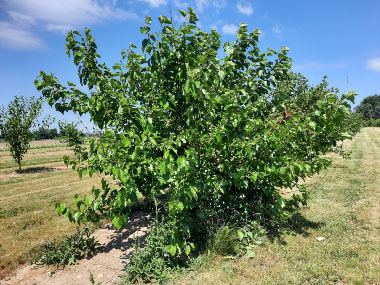
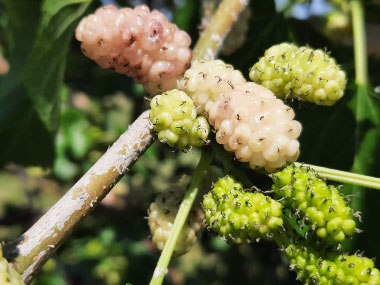
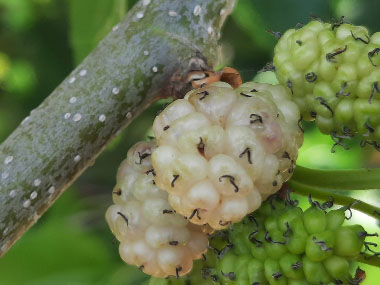
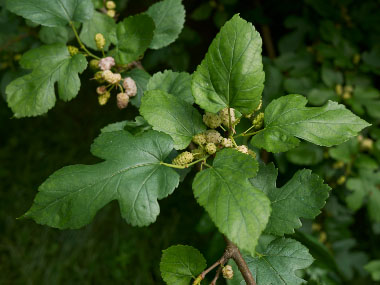
White Mulberry is native to China and is the favored food of silk worms. This tree is in the Moraceae family. It was introduced to North America in the 1600s for the purposes of attempting to establish a silk industry here. This is a fast growing tree that tolerates a variety of soil and moisture conditions. The mature fruit is much sweeter than the red mulberry. There are a few key ways to tell the difference between the red and white mulberry. Red mulberry leaves are mostly unlobed—two-and-three lobed (rarely more). In contrast, white mulberry leaves are mostly 3-to-7 lobed. Also, the upper leaf surface on red mulberry is a dull dark green, whereas white mulberry leaves have glossy tops. Red mulberry fruits are typically larger than those of white mulberry, and are always dark purple when ripe. White mulberry twigs and bark also tend to be more orange than red mulberry.

- click for video -
Trunk/Bark
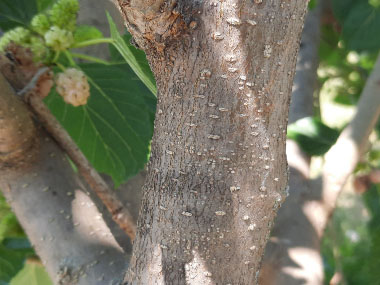
Mulberry has a short trunk that is often crooked and forms a rounded crown with a dense canopy of spreading branches. The bark of white mulberry is orangish-brown with furrowed ridges. Older bark becomes somewhat flat. The trunks can reach 50cm (20") in diameter at about 2 metres (6') high.
Branches/Twigs
Twigs are reddish to orange-brown with scattered, raised lenticels. New growth is slightly hairy becoming hairless the second year with the lenticels flattening out becoming somewhat white. Bark is thin, rough, turning gray to gray-brown with maturity.
Height
This tree typically grows up to 15 metres (50 ft) in height.
Leaves/Needles
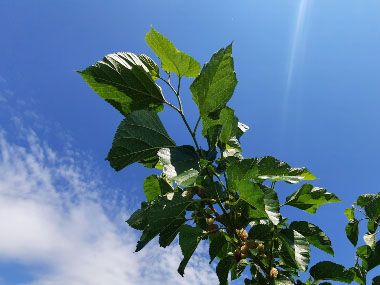
Leaves are alternate, and are variable in form. They can be unlobed or have 2 to 7 irregular lobes. The leaf margins are coarsely serrated. The tops are glossy and the undersides light green. Three major veins radiate from the base where the stalk meets the blade.
Flowers
Trees are usually dioecious, producing either all male florets or all female florets in the form of drooping catkins. There are some white mulberry trees that are monoecious (producing both male and female florets on the same tree). Male catkins are whitish or yellowish green, and cylindrical. Individual male florets consist of a tiny green calyx with 4 lobes, 4 stamens, and no petals. The stamens are bent downward during the bud stage, but straighten abruptly as the florets begin to open to fling their pollen. The blooming period occurs from mid-to late spring and the florets are wind-pollinated.
Fruit
Nodding to pendulous fruit grown 1.25cm to 3.81cm (½ to 1½") long. The fruit color ranges from white to pink to red, usually turning purplish-black when mature but sometimes remaining white.
Habitat
The tree prefers part shade to full sun. It likes moist to dry, disturbed soils. They are found along woodland edges, in thickets, and along streams. Although native to China, it has widely naturalized throughout temperate and tropical regions, including North America, South America, Europe, Africa, and Australia.
Edible Parts
The fruit and young leaves are edible.
Other Name
Silkworm Mulberry.
Recipes
Deep Fried Mulberry Leaves, Mini Mulberry Fritters, Mulberry Date Squares, Mulberry Granola Squares, Mulberry Pancakes, Mulberry Pineapple Loaf, Mulberry Tea, Stuffed Mulberry Leaves
Winter Survival Food Handbook

Types of Wild Food


Now available! Beginner's Guide to Safely Foraging for Wild Mushrooms